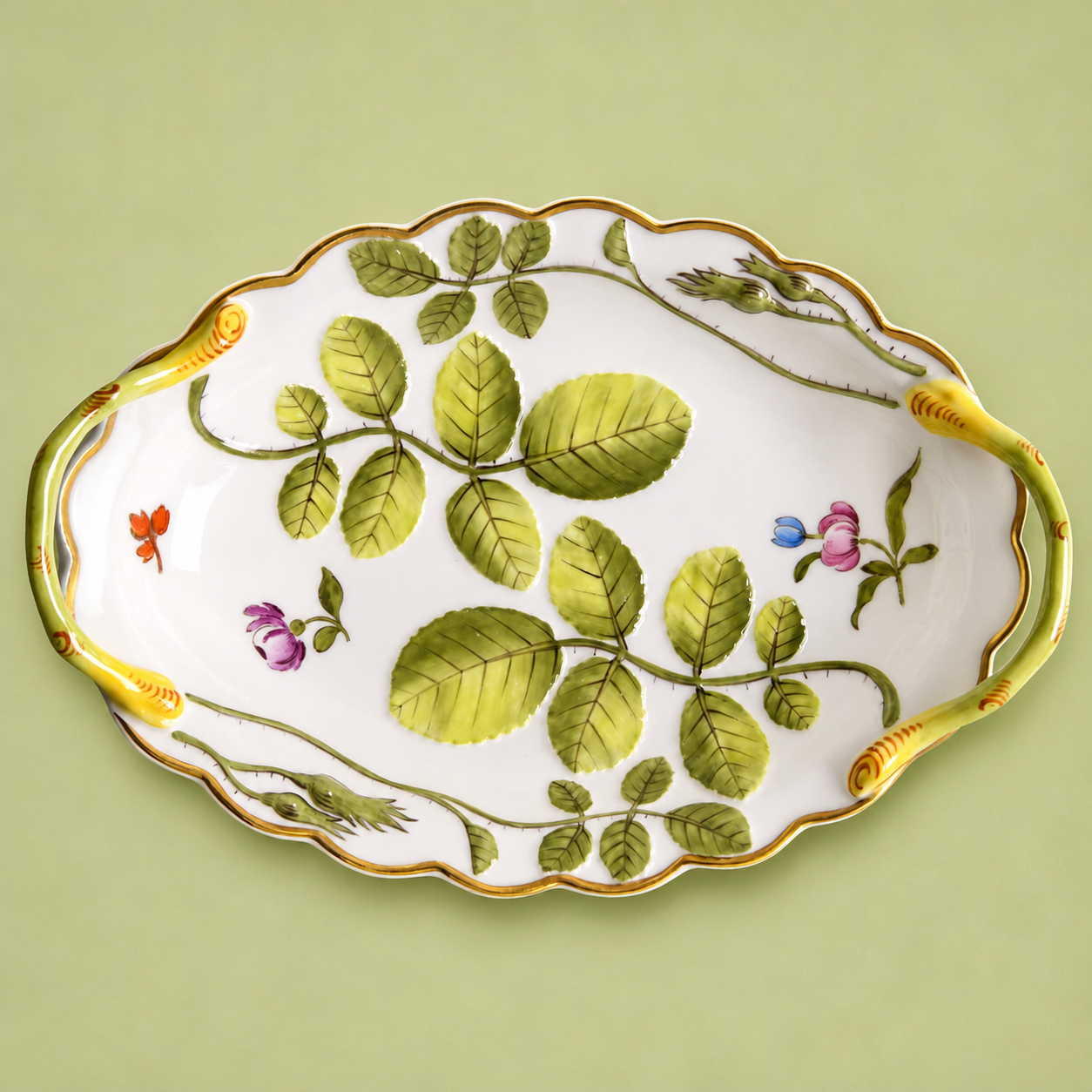
Recently, a dear friend made me aware of a china pattern which I’d never heard of before. So thank you Shelley Stewart of Mama’s Miracle Linen Soak for telling me about this fascinating pattern!

Some china patterns are admired for their beautiful colors, others for their delicate floral decorations or elaborate gilding. But few have a story quite as intriguing as Blind Earl. With its sculpted roses and distinctive three-dimensional decoration, this Worcester porcelain pattern has a history that reaches back to eighteenth-century England.

Its name suggests an unusual story involving an English earl who, after losing much of his eyesight, supposedly commissioned porcelain that he could appreciate through touch. It is a charming tale, but the actual history of Blind Earl is even more interesting. The pattern existed long before the Earl’s accident, and its later association with the Coventry family helped give it the name by which collectors know it today.
The Beginnings of Blind Earl
The story begins in Worcester, England, at the Worcester Porcelain Factory, established in 1751. During the eighteenth century, English porcelain manufacturers were competing to establish themselves in a growing market for fine tableware. Worcester became known for its inventive designs, colorful enamels, and finely crafted porcelain.


Blind Earl emerged during the factory’s early years, around the mid-1750s. Unlike patterns that relied entirely on painted decoration, Blind Earl incorporated three-dimensional ornamentation directly into the porcelain. Its defining feature was a moulded arrangement of rose leaves and buds rising from the surface of the plate or dish.
The raised foliage was often painted in shades of green and pink, complemented by hand-painted floral sprays and, on many examples, gilded scrollwork along a scalloped rim. The combination of sculptural relief and delicate enamel painting gave the pattern a distinctive appearance that could be appreciated by both sight and touch.
The Story of the Blind Earl
The name Blind Earl is traditionally associated with George William Coventry, the seventh Earl of Coventry, who lived from 1758 to 1831 and was the owner of Croome Court in Worcestershire.

According to the familiar story, the Earl suffered a serious hunting accident that left him with severely impaired eyesight. Wanting to continue enjoying beautiful objects despite his loss of vision, he supposedly commissioned a porcelain service decorated with raised roses and leaves. The tactile decoration allowed him to appreciate the design by running his fingers across the surface.
There is, however, an important detail that complicates this story. Worcester was already producing the raised rose-leaf design in the 1750s and 1760s. The Earl was not born until 1758, and his accident occurred much later. The pattern, therefore, could not have been created specifically for him.
So how did the Earl become connected to it? The answer lies with a later porcelain service commissioned by his family.
Lady Coventry’s Special Commission
Research published by the Friends of Croome offers a fascinating explanation of the family’s connection to the pattern.
Lady Coventry had seen the earlier raised-rose porcelain in her father’s collection and admired its unusual decoration. Knowing that her husband could appreciate the sculpted leaves and flowers through touch, she reportedly arranged for a new dessert service to be made especially for him.

In 1813, she ordered the service from Flight, Barr & Barr, bringing the distinctive design into the Earl’s household. It was a thoughtful gesture that connected an existing Worcester pattern with the man whose name it would eventually carry.
A substantial dessert service associated with the Coventry family survives today. Dating to approximately 1820, it includes deep dessert plates decorated with floral relief, painted bouquets, and gilded borders.
This later service helps explain the connection between the Earl and the pattern, while also providing an opportunity to compare two distinct periods of Worcester porcelain production.
Recognizing the Blind Earl Pattern
Blind Earl is relatively easy to recognize once you know what to look for. Its most distinctive characteristic is the moulded rose foliage rather than the painted flowers.

Look closely at the surface of a plate or dish. The leaves and rosebuds should rise directly from the porcelain itself. They are not simply painted outlines or applied transfers but part of the original moulded design.
Other identifying characteristics include:
- Raised foliage: Sculpted rose leaves and buds, frequently colored in shades of green and pink.
- Painted decoration: Hand-painted floral sprays and scattered blossoms that complement the relief.
- Scalloped rims: Undulating edges that echo the natural shapes of the foliage.
- Gilding: Many examples feature gold scrollwork and fine detailing along the rim.
Not every piece is decorated identically. The placement of the flowers, amount of raised foliage, and colors can vary. Some examples have elaborate floral decoration, while others are more restrained.

The combination of moulded and painted ornamentation is what makes Blind Earl particularly interesting to collectors. It showcases two different decorative techniques working together on a single piece of porcelain.
More Than Just Dinner Plates
The original Blind Earl production was primarily associated with the eighteenth-century dessert table rather than a conventional dinner service. During this period, dessert was an important part of formal dining, and specialized porcelain pieces were used to present fruits, sweets, and confectionery.

Several forms are associated with the early pattern.
Dessert plates are among the most recognizable examples, with their decorative relief and scalloped edges.
Sweetmeat dishes were smaller serving pieces intended for confectionery and other delicacies. Some examples feature unusual moulded handles that continue the naturalistic theme.
Spoon trays have elongated shapes and decorative handles, making them another distinctive form for collectors to recognize.

An interesting historical reference comes from a Worcester sale catalogue dated 1769, which listed twenty-four dessert plates described as rose-leaf plates. This provides evidence that the design was already established during the factory’s early production period.
Identifying Antique Examples
For collectors, identifying Blind Earl requires looking beyond the pattern name. The porcelain body, moulding, painted details, shape, and factory marks all provide useful clues.
Early Worcester examples were made from soft-paste porcelain. Their raised foliage should appear integrated into the original moulded form rather than looking like decoration applied afterward.

Marks can be helpful, although not every early piece is marked. Some Worcester examples carry period factory marks, including anchor marks and handwritten identification. A documented Worcester dessert plate dated 1768, for example, carries a red anchor mark.

Later Flight, Barr & Barr pieces may have different impressed or printed marks. These should be considered alongside the physical characteristics of the piece rather than used as the sole means of identification.

When examining a potential antique, pay particular attention to the raised leaves and buds, where small chips or losses can be difficult to spot. Also check the gilding for wear and look carefully for hairline cracks, repairs, and restoration.
Because the Blind Earl name has been used for later versions of the design, it is important to establish the period of production before assigning an age or value.
Blind Earl in Later Production
The Blind Earl name continued into later Royal Worcester tableware. Collectors may encounter several variations, including raised multicolored decoration, an all-white raised design, and versions without the raised relief.
These later patterns should not be confused with the original eighteenth-century Worcester pieces. Although they share the Blind Earl name, they represent different interpretations of the design and belong to different periods of production.

This distinction is important when researching a piece or determining its resale value. An eighteenth-century Worcester dessert plate, a nineteenth-century Flight, Barr & Barr piece, and a later Royal Worcester plate may share a name, but their historical significance and market values can be quite different.
A Pattern With a Story to Tell
Blind Earl is a wonderful example of how the history of china can be just as fascinating as its appearance. What began as an inventive use of moulded porcelain decoration eventually became associated with an aristocratic family and a story of beauty appreciated through touch.

Its history tells us much about the craftsmanship and creativity of early English porcelain makers, while the connection to the Coventry family adds a personal story that has endured for generations.
Perhaps that is what makes Blind Earl so special. It is a design that brings together sculpture, painting, history, and a little bit of mystery.
For collectors, finding an early example is like holding a small piece of Worcester’s porcelain history in their hands. And with those raised roses, it is a piece of history that can quite literally be appreciated by touch.



Leave a Reply