There is something almost magical about Johnson Brothers’ Friendly Village. A little red schoolhouse sits beneath bare winter trees, a covered bridge crosses a rushing stream, and a mill stands quietly beside the water. In another scene, sugar maples wait for spring while elsewhere the village disappears beneath a blanket of snow. The scenes feel familiar, almost like places we have visited or remembered from childhood—and that was precisely the point.

Introduced by Johnson Brothers in 1953, Friendly Village became one of the company’s most enduring patterns. The English-made version remained in production until 2003, with the pattern continuing in later production. But perhaps the most charming part of its story is also the simplest: there was no Friendly Village.
It wasn’t an illustration of one particular English village or American town. Instead, it was an imaginary community assembled from the familiar images people associated with an idealized rural America—a little New England, a little small-town America, a touch of the English countryside, and a whole lot of nostalgia.
And somehow, Johnson Brothers made it feel real.
An English Company Making China for Americans
To understand Friendly Village, it helps to understand Johnson Brothers. Founded in 1883 in Hanley, Staffordshire, one of England’s great pottery-producing regions, the company became particularly successful in the American export market. Its dishes were made in England, but many of its designs were created with American consumers in mind.
That became especially important after World War II. America was entering a period of tremendous prosperity, and families were buying houses, automobiles, appliances, furniture—and dinnerware. A matching set of dishes represented more than something to eat from; it was part of creating a comfortable and attractive home.
Manufacturers understood that consumers weren’t just buying objects. They were buying feelings.
After the war, Staffordshire manufacturers increasingly produced patterns featuring idyllic farms, villages, gardens and small-town scenes. These images offered an escape from an increasingly modern world and evoked the comforting ideas of hearth, home and a simpler way of life. Friendly Village was an almost perfect expression of that desire.
The Woman Who Helped Create the Village
The origins of Friendly Village can be traced to 1948, when designer Louise Flather, associated with Macy’s Department Store in New York, brought sketches for a proposed pattern to Johnson Brothers executive Bill Norbury. The concept was to create a design inspired by American country life—not a picture of one actual town, but an idealized vision of one.

Turning that vision into dinnerware was no small undertaking. The scenes required extensive engraving work, and according to Norbury’s recollections, twenty-eight men were involved in engraving the pattern over a period of years. Those tiny scenes of bridges, mills, schoolhouses and farms therefore represent a remarkable amount of skilled craftsmanship.
A Village Built One Plate at a Time
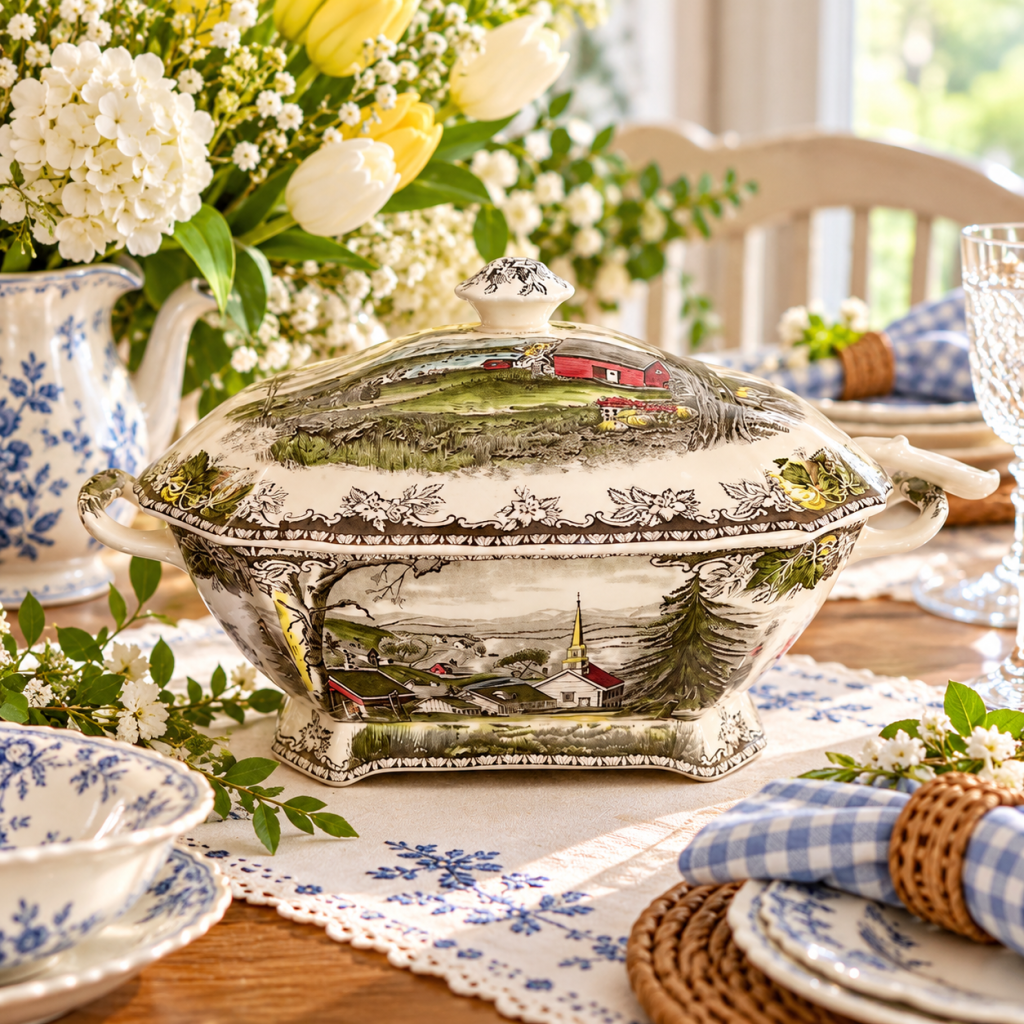
One of the cleverest aspects of Friendly Village is that the dinnerware doesn’t simply repeat the same picture. Different pieces reveal different views of the imaginary community, allowing the village to unfold as you collect and use the dishes.
The twelve principal dinner and buffet plate scenes are:

The School House

The Covered Bridge

The Old Mill

The Village Street

The Hayfield

Autumn Mists

Willow by the Brook

The Lily Pond

Sugar Maples

The Well

The Stone Wall

The Village Green
Other Friendly Village pieces introduced additional scenes, including The Ice House and The Apple Orchard, expanding the world beyond the familiar dinner plates.


That variety gives a complete Friendly Village table the feeling of a tiny landscape gallery. Your dinner plate might show the School House while your salad plate reveals the Covered Bridge. A cup might feature the Ice House, while a serving platter brings the Village Green into view. Instead of a table filled with identical dishes, you’re looking through a collection of windows into the same imaginary town.
The dishes don’t simply decorate the table—they tell the story of the village.
Even the Backstamp Tells a Story
If you’ve ever turned over a Friendly Village piece, you’ve probably noticed that the backstamp is more than a manufacturer’s mark. It often continues the storytelling with a small mailbox illustration and the name of the individual scene. A typical example might read “The School House – The Friendly Village – Made in England by Johnson Bros.”

The backstamp may also mention that the decoration is applied under the glaze, along with references to permanent, acid-resistant colors and genuine hand engraving. Even the bottom of the plate was therefore part of the sales pitch, assuring buyers that these were durable, carefully decorated English wares designed for everyday use.
The Colors That Made Friendly Village Timeless
Friendly Village has also benefited from its wonderfully restrained color palette. Instead of the bright, unmistakably mid-century colors found in some patterns of the era, Johnson Brothers used mossy greens, warm browns, muted reds, gentle blues, creamy ivory and subtle touches of yellow.

The result is a palette that feels both nostalgic and timeless. Friendly Village works beautifully with the rich colors of autumn, feels perfectly at home on a Thanksgiving table and becomes especially cozy during the Christmas season. Because the colors are earthy and muted, however, the pattern never feels overwhelmingly “1950s.”
That versatility may be one reason people who grew up with Friendly Village continue to cherish—and actually use—it today.
The Secret Is Nostalgia
Friendly Village appeared in 1953, only a few years after World War II, when America was changing rapidly. Suburbs were expanding, television was becoming part of everyday life and families were moving into new homes filled with modern appliances and furnishings. Yet on the dinner table was a pattern that seemed to belong to a slower, more predictable world.
There were village streets, wooden fences, maple trees, a schoolhouse, church, mill and covered bridge, along with snowy roads and quiet streams. Historical research into Johnson Brothers and Staffordshire tableware suggests that this imagery was deliberate. Manufacturers understood that American consumers responded to ideas of hearth, home, rural life and nostalgia.
Friendly Village was intentionally nostalgic. Nostalgia was part of the product.
The “American” Village Made in England
There is a wonderful contradiction at the heart of Friendly Village: it looks unmistakably American, yet it was made by an English company in Staffordshire.
Johnson Brothers had spent decades learning what appealed to the American market, making Friendly Village an excellent example of cultural exchange. An American designer brought sketches to an English pottery company; English craftsmen engraved the scenes; the dishes were produced in Staffordshire; and then they crossed the Atlantic to become part of American family life.
In that sense, Friendly Village is an American story told through English pottery.
A Village for Every Season
Seasonality adds another dimension to the pattern. Some scenes are unmistakably wintry, while others suggest spring, summer or autumn. The School House is surrounded by snow, while Sugar Maples evokes the transition toward spring and the tradition of collecting maple sap.

This changing scenery allowed Friendly Village to work throughout the year, while the snowy scenes became particularly popular for Thanksgiving and Christmas tables. The pattern could change with the seasons while maintaining the same comforting sense of place.
Dinnerware Designed to Become an Heirloom
Friendly Village wasn’t precious porcelain meant to sit behind glass. It was sturdy, everyday dinnerware designed to be used, and its long production run allowed families to add pieces over the years rather than replace an entire service.
That longevity is where the story becomes especially personal. Imagine a family purchasing Friendly Village in the 1950s—a few dinner plates, cups and saucers and perhaps a serving platter. Over the years, more pieces were added, a few were broken and replacements found. Decades later, the collection was passed down to another generation.

Suddenly, an old plate wasn’t simply a plate. It was the Thanksgiving table from childhood, Christmas dinner, Sunday supper and family gathered around the kitchen table. The pottery became a container for memories.
That emotional connection is a large part of Friendly Village’s enduring appeal.
A Remarkably Long Life
The English-made version of Friendly Village is generally documented as 1953–2003, an extraordinary production run for a dinnerware pattern. Johnson Brothers eventually became part of the Wedgwood Group in 1968, during a period when British pottery manufacturers were facing increasing competition and changing consumer tastes.
Yet Friendly Village endured. It survived changing decorating styles and shifting ideas about the modern dinner table and continued long after much of Britain’s traditional pottery industry had declined. More importantly, people continued to want it.
And Then There’s the “China” Question
Collectors commonly call Friendly Village “china,” but technically it isn’t porcelain. The pattern is earthenware/ironstone, a distinction worth knowing when researching pieces for collecting or resale.
Its sturdy body was part of the appeal. This wasn’t delicate tableware that needed to be handled with white gloves; it was made for the dinner table and everyday family life. That practicality may be another reason the pattern became so beloved.
The Friendly Village Treasure Hunt
For collectors, one of the most entertaining aspects of Friendly Village is the variety of individual scenes, shapes and serving pieces. Once you recognize the pattern, you stop seeing a pile of dishes and start looking for pieces of the village.

Instead of thinking, “There’s another Friendly Village plate,” you find yourself wondering, “Wait—that’s the Covered Bridge. Do I have that one?”
Johnson Brothers produced an enormous variety of pieces, making the search surprisingly addictive. And it’s important to remember that rare and valuable aren’t necessarily the same thing. Some pieces were produced in smaller quantities, while others are simply difficult to find because families used them until they broke, disappeared or became separated from their original sets.
The Pieces Worth Watching For
The giant 20-inch turkey platter is one of the first pieces I’d look for. Measuring approximately 20 inches long by 15½ inches wide, it was designed for serving a Thanksgiving-sized bird. Its size made it difficult to store, and because it was a practical serving piece, many examples were heavily used. Finding one in excellent condition can therefore be quite a thrill.

Large covered tureens are another exciting discovery, particularly when the original lid is present. The scenic decoration often continues across both the body and lid, making a complete example especially attractive. If you find one, check carefully to make sure the lid belongs to it.
The coffee pots and teapots are favorites because their curved forms allow the scenery to wrap around the piece. A teapot featuring Sugar Maples, for example, provides an entirely different view of the pattern than a flat plate.

Then there are the unusual pieces from the later Friendly Village Collectibles line, including the figural church cookie jar, snow globes, dome clock, figural salt and pepper shakers, matching tray and figural pitcher. These pieces took the Friendly Village concept beyond traditional tableware and turned the imaginary village into three-dimensional objects.

Even the smaller pieces can be fascinating. A child-size mug featuring The Ice House, for example, may not be particularly valuable, but it can be difficult to encounter and offers another glimpse into how deeply Friendly Village became part of family life.
Other forms worth watching for include square cereal bowls, gravy boats with their original underplates and covered butter dishes. They may not be the rarest pieces, but they’re easy to overlook when sorting through a large collection.
Every Friendly Village Table Is a Little Different
Because the individual pieces depict different scenes, two people can both own “a set of Friendly Village” and have completely different villages.
One family might have The School House, Covered Bridge, Old Mill and Village Green, while another might have Sugar Maples, Hayfield, Lily Pond and Willow by the Brook. Each collection becomes its own version of the imaginary community.
That’s what makes collecting the pattern feel almost like assembling a jigsaw puzzle. There is no single piece that tells the whole story—you have to put the village together yourself.
More Than a Dinnerware Pattern
Perhaps Friendly Village’s greatest achievement isn’t that it created a convincing imaginary town, but that it became part of so many real homes and real family traditions.
For more than half a century, these dishes were used for everyday meals as well as special occasions. They sat on kitchen tables, held Sunday dinners, served Thanksgiving turkeys and appeared at Christmas gatherings. Because the pattern remained available for so many years, families could gradually add pieces as their needs changed, replacing broken dishes or adding serving pieces along the way.
That long life gave Friendly Village something that many vintage patterns never acquire: a history that belongs to the people who used it. A particular plate might remind someone of their grandmother’s dining room, while a familiar mug brings back memories of childhood breakfasts. For another collector, discovering the same piece decades later at an estate sale can feel like finding a small connection to someone else’s story.

Perhaps that’s why Friendly Village continues to attract both collectors and people who simply want to use the dishes they remember. The scenes may depict an imaginary community, but the memories attached to them are very real.
And that is what makes Friendly Village more than a dinnerware pattern. It became a backdrop for family life—and, in doing so, became part of the family story itself.

Are you enjoying this blog? If so, I would love it if you left a like or even a comment! It helps me to know if people are enjoying these little forays into history. The more feedback I get, the more I’m encouraged to keep doing this! Thank you. – K.




Leave a Reply